
The Devil in Peter Pan
What's really going on in this story? Part II

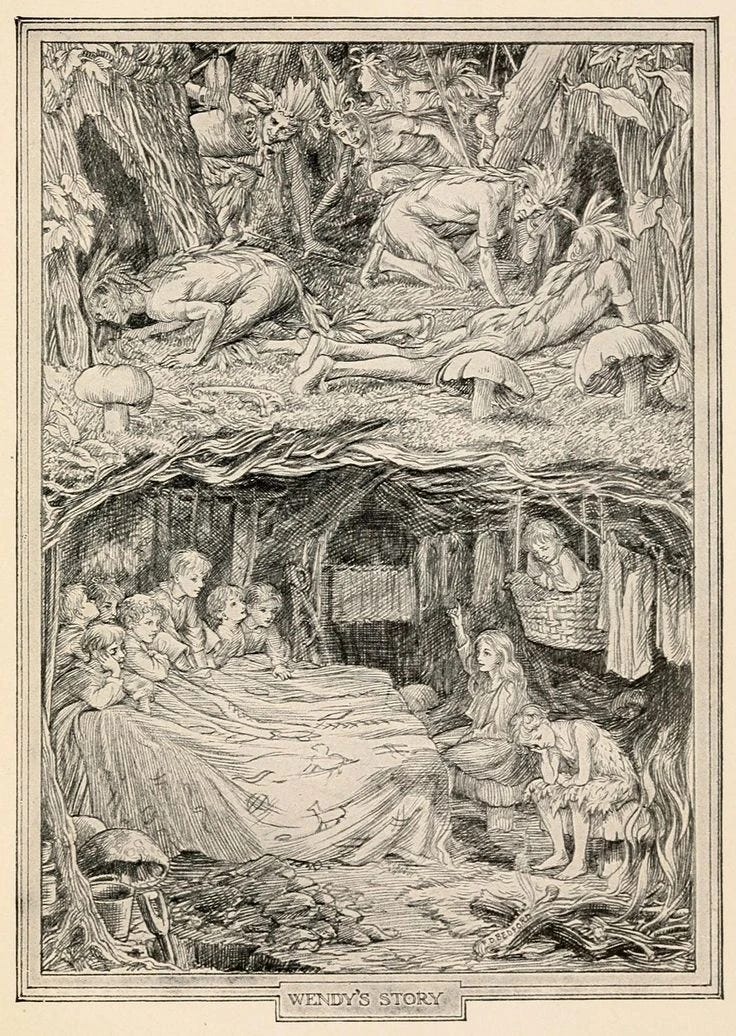
Peter Pan flew in through the window of Darling children’s nursery in order to listen to stories, Peter tells Wendy. He and the lost boys know no stories. The maternal Wendy is deeply saddened by this. She insists that Peter stay—she knows lots of stories!
“Those were her precise words, so there can be no denying that it was she who first tempted him.
[Peter] came back, and there was a greedy look in his eyes now which ought to have alarmed her, but did not.
‘Oh, the stories I could tell to the boys!’ she cried, and then Peter gripped her and began to draw her toward the window.
‘Let me go!’ she ordered him.
But Peter Pan “had become frightfully cunning. ‘Wendy,’ he said, ‘how we should all respect you.’” He knows just how to get to Wendy, telling her that she would tuck the boys in at night and darn their clothes and make pockets for them—“none of us has any pockets.”
And so the children fly off to Neverland with Peter. It is a long and exhausting flight around the world, and when they arrive, the mists of their former romantic notions about Neverland immediately dissipate. Neverland “was real now, and there were no night-lights, and it was getting darker every moment.” The Indians are on the war path and the pirates are after the lost boys.
Peter points to a pirate asleep in the jungle beneath them. “If you like, we’ll go down and kill him,” Peter tells John.
“‘Suppose,’ John said, a little huskily, ‘he were to wake up.’
Peter spoke indignantly. ‘You don’t think I would kill him while he was sleeping! I would wake him first, and then kill him. That’s the way I always do.’
It turns out that Peter has killed many of pirates—“tons,” he says.
If Barrie didn’t constantly break the fourth wall to remind his readers that we’re just having fun and play-acting, then we might be more alarmed by his “children’s” story. Barrie’s Peter is not Disney’s sprightly and childish boy. He is vain, conceited, tyrannical, perhaps even demonic. But Barrie’s subtle and humorous delivery somewhat disguises the evil in Peter’s character.
Peter does not allow the lost boys to break their make-believe play or he raps them on the knuckles; he expects them to cheer on his return; he forbids them “to look in the least like him”—this is why they wear animal skins. As for the twins,
“Peter never quite knew what twins were, and his band were not allowed to know anything he did no know, so these two were always vague about themselves, and did their best to give satisfaction by keeping close together in an apologetic sort of way.”
Yet these quirks, shall we say, of Peter’s and even the constant flow of blood on the island are meant to make us chuckle. We are to feel sorry, somehow, for the lost boy Tootles who always manages to miss out on the fun, returning when “the others would be sweeping up the blood.”
Peter Pan’s character is such a strange mix that we are not entirely sure what to make of him. Barrie tries to make it clear that he is not a sympathetic character, and yet we instinctively want to sympathize with the boy who won’t grow up. When the children are making their long flight around the world before getting to Neverland, little Michael continually drifts off to sleep. Wendy cries to Peter to save him, but Peter always waits until just before Michael hits the sea to grab him. “[Y]ou felt it was [Peter’s] cleverness that interested him and not the saving of human life. Also he was fond of variety, and the sport that engrossed him one moment would suddenly cease to engage him, so there was always the possibility that the next time you fell he would let you go.”
Peter’s—what should we call it?—sociopathy? prevents him from forming friendships with the lost boys. I suppose it’s no wonder because when the boys get to be too old, Peter kills them (“The boys on the island vary, of course, in numbers, according as they get killed and so on; and when they seem to be growing up, which is against the rules, Peter thins them out.”) And Peter is so forgetful that he even loses track of who Wendy is when they are flying to Neverland.
An unruliness characterizes Peter. He wreaks havoc on the island, terrorizing his band of brothers and murdering the pirates (who, it has been speculated, are former lost boys who escaped Peter killing them). Yet Peter’s wild energy and taste for “adventure” is not really childlike. It seems to have more in common with the frenzied nature of Pan, the Greek god.
Peter’s pipes seem to be Barrie’s way of showing us their kinship. Barrie studied classics and Pan would have been well-known to him. Pan lived outside of civilization in uncultivated nature, and he loved to create chaos. He played his pipes as a way of hypnotizing his victims (it happens that Barrie was drawn to one of London’s literary giants, George du Maurier, who was fascinated with hypnotism and practiced it himself; it figures prominently in his wildly popular novel Trillby. Barrie had hoped to meet du Maurier, but he died before he could. Instead, Barrie “happened” upon his grandchildren—the Llewelyn Davies boys in Kensington Gardens one day).
Most stories of Pan have it that he was so hideous his mother rejected him after birth. Peter, recall, flew out the window when he was 7 days old and when he returned, his mother had barred the window and was holding another baby. Barrie’s own feelings of rejection as a child after the death of his brother must have figured into this mythic creation as well.
Take a look at Pan next to the illustration of Peter from Peter and Wendy. Does Peter not have the illusion of horns?
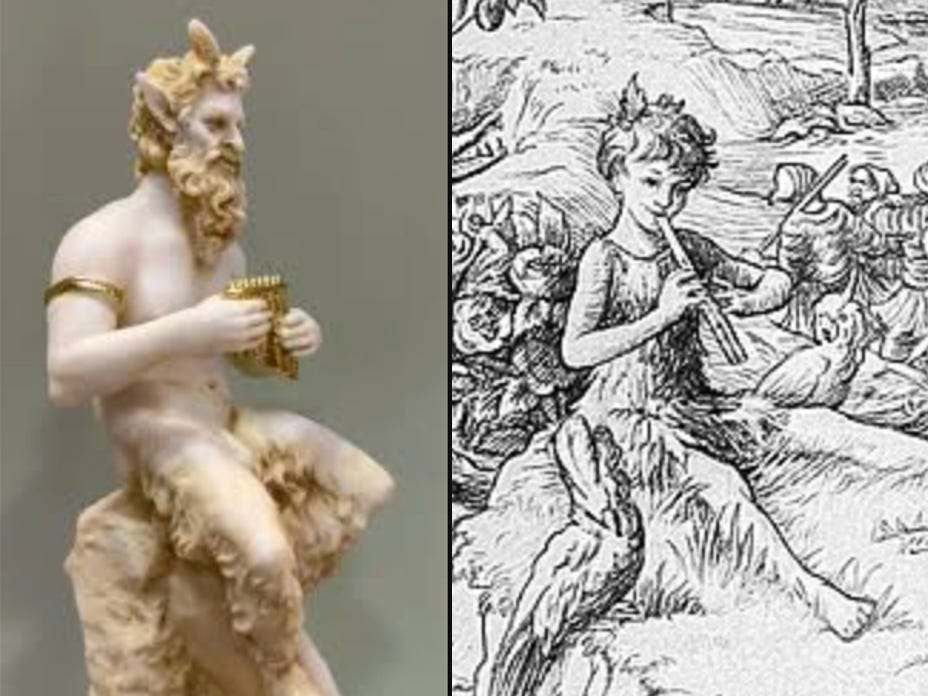
The word “panic” comes from Pan, as he would put those around him in a frenzy. And here we have Peter, like a wrecking ball on the island. He terrifies even the pirates. In the early versions of the story, Peter Pan was actually the villain. Hook did not exist. And Barrie had originally called the stage play “Peter Pan, or The Boy Who Hated Mothers.” The producers gently suggested a different title.
The early Church fathers believed that the pagan gods, including Pan, were demons. Nor was this a fringe belief. Saint Justin Martyr (110-165) wrote that, having heard from the prophets that the Christ was to come, the demons “put forward many to be called sons of Jupiter, under the impression that they would be able to produce in men the idea that the things which were said with regard to Christ were mere marvelous tales, like the things which were said by the poets.” That is, the demons (fallen angels) were trying to deceive humanity by telling stories that would imitate or pervert the true story of the Logos. Justin Martyr says,
The prophet Moses, then, was, as we have already said, older than all writers; and by him, as we have also said before, it was thus predicted: ‘There shall not fail a prince from Judah, nor a lawgiver from between his feet, until He come for whom it is reserved; and He shall be the desire of the Gentiles, binding His foal to the vine, washing His robe in the blood of the grape.’ The devils, accordingly, when they heard these prophetic words, said that Bacchus was the son of Jupiter, and gave out that he was the discoverer of the vine, and they number wine [or, the ass] among his mysteries; and they taught that, having been torn in pieces, he ascended into heaven.
Saint Paul, Athenagoras of Athens, Tertullian, Clement of Alexandria, Origen, Lactantius, Eusebius, Saint Augustine, and other Christian fathers and Second Temple Jewish literature shared this perspective. It was mainstream.
“We wrestle not against flesh and blood, but against principalities, against power, against the rulers of the darkness of this world, against spiritual wickedness in high places.”
Zephram Foster at Ad Fontes recalls an interesting episode from history about the death of Pan:
The story, according to Plutarch, goes like this: sometime during the reign of Tiberius, an Egyptian mariner named Thamus was sailing to Italy by way of Greece, and on the deck of his ship heard a voice from heaven address him by name. The great loud voice told Thamus that when he arrived at shore, he was to announce to all that “the great god Pan is dead.” Thamus followed his orders, and the news was met with great cries and groans. The great god Pan was dead–what did this mean?
One important thing to note–and this is my favorite part–is the time frame. This happened during the reign of Tiberius. There was another somewhat significant event that took place while Tiberius was in charge. Namely, the death, burial, and resurrection of the Lord of all creation.
Peter hates the one who begot him (his mother) no less than Pan hates the one who begot him (God)—and it might be added that Barrie, too, resented his mother. The chaos that these two Pans create is as a result of their rebellion against their creator, the one to whom they owe love and devotion. We can see Peter’s longing (and Barrie’s, too) for this thing which he has rejected in the character of Wendy, who acts as a surrogate mother to the lost boys. This aspect of the story is the most touching, and we want to cling to it as if it were the whole story—a story of boys in need of mothers. But this, if I dare say it, is the romantic veneer that disguises the true heart of the story of Peter Pan.
In early drafts, Barrie referred to Peter as the “demon boy.” Peter was a villain who kidnapped children from their beds. Later, when a statue was erected in Kensington Gardens of Peter Pan, Barrie famously said, “It doesn’t show the devil in Peter.” We can’t be sure if Barrie was entirely aware of what he was creating. Art has a way of defying strict categorization and escaping the intentions and even full knowledge of its creator.
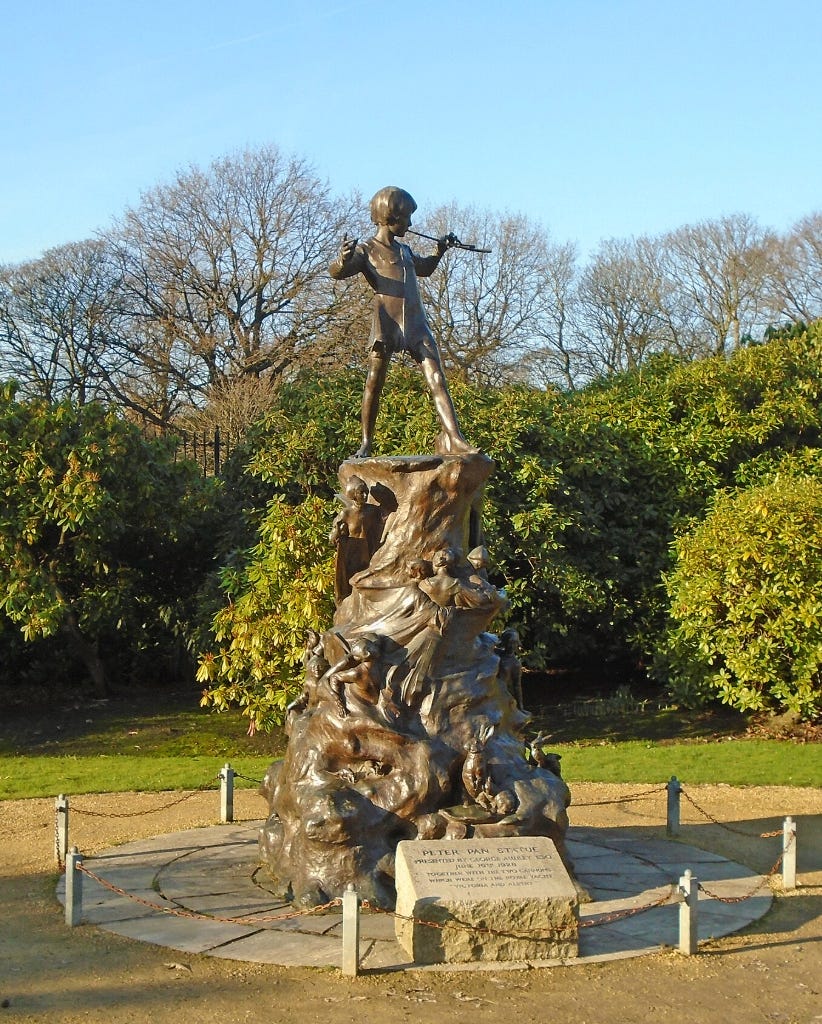
Still, there is no escaping the romantic dimensions of Peter Pan. It is, in part, a sentimental story of a boy who doesn’t grow up. But it is also a dark, even nihilistic, tale of life apart from Christian morality and civilization. This story follows the classic path of all romantic imaginings: the dream turns to nightmare.
It is impossible to understand modernity and the degeneracy of Western culture apart from Romanticism. Peter Pan is a romantic story. But the interpretive key to it is not so much Rousseau as Nietzsche. The Übermensche is the culminating personality type of romantic sentimentalism. Nietzsche’s superman fills the void left by our cultural abandonment of Christian morality. The sentimental-humanitarian ethic of Romanticism encouraged us to throw off all civilizing and restraining forces so that “natural man” could be free to create an earthly utopia. But the result of destroying Christendom and unleashing man’s inner “goodness” was not the will to brotherhood (as Rousseau et. al. would have us believe) but the will to power. Peter Pan, I would argue, personifies this.
Peter, in rejecting adulthood (he had informed Wendy that the very mention of his becoming an adult drove him to escape straightaway) rejects not just some abstract thing but the concrete aspects of life as an adult: marriage, fatherhood, a vocation, manners, civilized behavior. Peter can be seen to represent the Nietzschean figure who has transcended Christian morality and created his own moral schema.
As Nietzsche might have predicted, Peter uses his liberation not to create brotherhood with his fellow liberated boys but to gratify his own lust for power. With procrustean enforcement, Peter kills the boys who no longer serve his fantasy. He single-mindedly pursues the pirates, the war with which Peter started. The scale of values that Peter asserts in place of the old one he rejects is one of Peter’s own making. He is like a god on Neverland—or, rather, a demon.
“The imagination of the superman [Übermensch],” Irving Babbitt observed in Rousseau and Romanticism, “spurning every centre of control, traditional or otherwise, so cooperates with his impulses and desires as to give them ‘infinitude,’ that is so as to make them reach out for more and ever for more,” Babbitt said. “The result is a frenzied romanticism.” I couldn’t think of a better way to describe Peter Pan.
Babbitt argues that the Übermensch is “a most authentic descendant” of romanticism. Babbitt references a passage from Nietzsche’s Thus Spoke Zarathustra:
“Out into distant futures, which no dream hath yet seen, into warmer souths than ever sculptor conceived . . . Let this love be your new nobility, — the undiscovered in the remotest seas.”
This is the romantic dream set before our eyes—a Neverland, where, as Barrie says in the beginning of the novel, “we can still hear the sound of the surf, though we shall land no more.” It is the place of the heart’s content, which probably never was, and yet which the Romantic longs for. But this is the dream-side of the dual-natured Romantic imagining. The nightmare is its other side.
Why does dream turn to nightmare in every Romantic fantasy? Because we are not as gods. When we reject the Creator’s parameters for reality and try to invent our own, as little Übermenschen, there is only one way that things can go: south. Throwing off the very institutions and systems of support that bring us closer to God—the family, the faith, prayer, work, etc.—does not make us into “noble savages.” It only makes us savages. Peter Pan personifies this.
As Edmund Burke observed after the Revolution eviscerated civilization in France, “power, of some kind or other, will survive the shock in which manners and opinions perish; and it will find other and worse means for its support.” Once civility and morality are destroyed as mere vestiges of “white privilege” or whatever else the revolutionaries call it, a greater and more diabolical power will emerge.
The danger of Peter Pan is that Barrie makes his romantic vision entertaining and attractive. Barrie need not hide the ugly side of the romantic vision—the tyranny, the killing, the kidnapping—he need only make it appear funny, “childlike,” “imaginative,” “original.” And once he has done that, he succeeds in heading off criticism of his vision. Even now, to call into question iconic stories such as Peter Pan is to seem “puritanical,” as if the alternative to such “wild vagabondage of imagination,” to borrow Babbitt’s delightful phrase, must be puritanical morality tales.
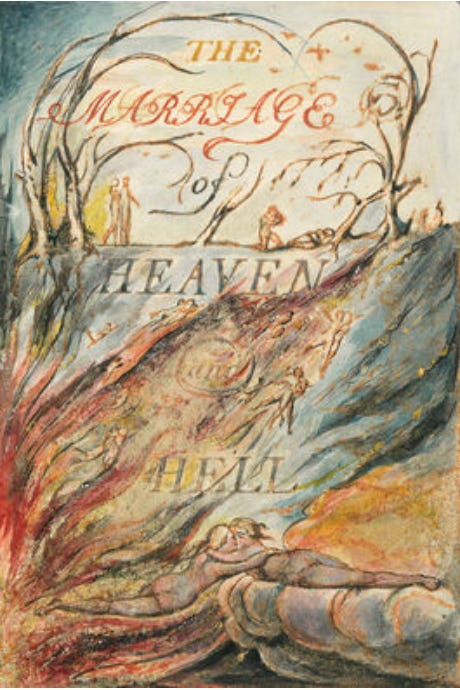
But morality tales do not capture the imagination. And if Barrie has taught us anything, it is that the imagination is key. Capture it, and you can convince a person of anything. You can pass off ugliness as beauty; death as life; lies as truth; demons as gods. So the antidote to romantic imaginings is not morality tales or self-conscious “Christian stories.” It is works of imagination that deepen our understanding of reality. Stories informed by a moral imagination, rather than a romantic imagination, heighten our sense of the real, even as they operate through a “veil of illusion.” All of these stories will be Christian in nature because they will, in one way or another, reflect reality back to us. There is no reality apart from the Christian reality.
George MacDonald said that “In physical things a man may invent; in moral things he must obey—and take their laws with him into his invented world as well.” Barrie violates this cardinal rule, and the result is a Romantic bipolarity that manifests, by turns, as sentimental idyll and Nietzschean will to power.
All of this has caused me to think twice before handing my kids “children’s classics” (to say nothing of modern, mainstream children’s books). It makes me think that all books must be carefully vetted. This may sound extreme, but the imagination forms a child’s relationship with reality itself. My preliminary conclusion is that Romanticism permeates many children’s stories, and given where our culture is, especially in our near-obsessive desire to “get kids reading,” we might perhaps pause and pay closer attention to what they’re reading.
This is so interesting. I was talking some about it with Robert and he mentioned that when Jesus says to Peter that "...you are Peter, and on this rock I will build my church, and the gates of Hades will not overcome it" he said that in Caesarea Philippi, which had been called Panias or Panion which means "sanctuary of Pan." And there was a rocky cave there which was considered to be a gateway to the underworld and many horrific sacrifices were made there every year to Pan. And maybe that's exactly where Jesus was standing and part of what he was doing was challenging Pan. It gives me chills to think about that in relation to the quote about Thamus announcing that "the great god Pan is dead" from around the same time.
https://www.thattheworldmayknow.com/gates-of-hell-article
Well, I'll take Peter Pan off the bookshelf. This also makes me want to go find and read what C.S. Lewis says about mythology. I really love Till We Have Faces.
I agree that the actual story of Peter Pan is chaotic and has its dark side. I'll telegraph some of my thoughts as I read your piece... maybe some friendly sed contras?
When I read Peter Pan aloud to my youngest daughter (I think she was 10 or 11?), my thought was that the ending put it all into perspective.
I think deeper, enduring childhood stories acknowledge the conflict the child feels between wanting to be autonomous but knowing at some level that he doesn't have the self control and maturity to live without his parents, who are so troublesome to him and perhaps not really mature themselves. The fear engendered by this conflict is handled in the best of stories and is what gives them longevity.
The pagan elements don't trouble me in themselves. The tradition in that era of British writing is to take the delight (or humorous quality) and leave the darkness behind. Otherwise, what do we do with the Piper at the Gates of Dawn, or Mr. Tumnus, or E. Nesbit's Phoenix? There is a level where the Christian imagination is just not afraid of these characters, any more than Americans paid attention to the dark side of Indians' beliefs and just took the enchanting ones to heart.
The key to Peter Pan is in the ending. The ending brought my daughter and me to tears -- we were crying together and I could hardly finish. This might have something to do with my feeling that my "baby" (she's the youngest of my 7) would not be having stories read to her for much longer! Maybe it was my very own Peter Pan moment! But -- my thought was that it was tender and redeeming in showing the child that the order and happiness of home are best. The mother in particular stands out as being a satisfying figure for that inner child who, after all, is not doing well on his own.
It's troubling when an author has a background -- I remember being disturbed to find out that E. Nesbit was a Socialist! And I agree that Alice in Wonderland is a strange story to read to children, though we all do. I do think, though, that the art stands apart from the character of the artist, or can. If a story has stood the test of time (even if part of that time its popularity has to do with its Disneyfication), it deserves the benefit of the doubt.
But now it's been quite a long time since I've read this story. I guess maybe 16 or 17 years? So I don't know. I could be quite wrong! As I say, I'm just throwing some thoughts out there from memory!